(203) 550-1846
 rwinsulation@gmail.com
If you’re comparing insulation options for a home in Fairfield, New Haven, or Litchfield County, the choice usually comes down to two types of spray polyurethane foam: open-cell and closed-cell. Both outperform traditional fiberglass or cellulose in terms of air sealing, but they behave very differently once installed — and picking the wrong one for a given space can mean paying for performance you don’t get. Here’s how they compare, and where each one makes sense in a Connecticut home.
What’s the Difference Between Open-Cell and Closed-Cell Spray Foam?
Open-cell foam is lighter, spongier, and more flexible because the tiny cells inside it are left open and filled with air. Closed-cell foam is denser and rigid because its cells are fully encapsulated, which traps a high-performance gas inside each cell instead of air. That structural difference is what drives nearly every other distinction between the two — insulating power, moisture behavior, sound transmission, and cost.
R-Value: How Much Insulating Power Do You Get Per Inch?
Closed-cell foam insulates roughly twice as effectively per inch as open-cell foam. Open-cell spray foam typically provides about R-3.5 to R-3.6 per inch, while closed-cell foam provides about R-6 to R-7 per inch. In practice, that means closed-cell foam can hit code-required R-values in a much thinner layer — which matters in tight spaces like rim joists or shallow roof rafters where you can’t afford to lose interior depth.
| Open-Cell Foam | Closed-Cell Foam | |
|---|---|---|
| R-value per inch | ~R-3.5–3.6 | ~R-6–7 |
| Density | Low, spongy | High, rigid |
| Moisture resistance | Absorbs water, vapor-open | Water-resistant, vapor barrier at ~2″ |
| Sound dampening | Excellent | Moderate |
| Adds structural rigidity | No | Yes |
| Typical use case | Interior walls, attics, sound control | Basements, crawl spaces, rim joists, exterior walls |
Which One Handles Moisture Better?
Closed-cell foam is the better choice anywhere moisture is a real concern — basements, crawl spaces, and band/rim joists, all common trouble spots in older Connecticut homes near the coast or in flood-prone areas. Because its cells are sealed, closed-cell foam doesn’t absorb water and functions as a vapor barrier at roughly two inches of thickness. Open-cell foam is vapor-open and will absorb and hold moisture if it gets wet, which is why we generally avoid it below grade or in any assembly where bulk water is a realistic risk.
Which One Is Quieter?
If soundproofing between rooms, or blocking road noise, is a priority, open-cell foam has a real advantage. Its spongy, open structure absorbs sound waves rather than reflecting them, which is why it’s often the better pick for interior walls around home offices, media rooms, or bedrooms — even in situations where its lower R-value isn’t a limiting factor.
Does Either One Add Structural Strength?
Closed-cell foam does. Once cured, it bonds tightly to framing and adds meaningful rack strength and rigidity to a wall assembly — a genuine, if secondary, benefit in older homes with less robust framing. Open-cell foam doesn’t add structural strength; it stays flexible after curing, which is actually useful in assemblies that need to allow for some natural building movement without cracking the insulation seal.
What About Cost?
Closed-cell foam costs more per board foot than open-cell foam, both because of the higher-density material itself and because it delivers more R-value per inch. Open-cell foam is generally more economical for covering large volumes — like a full attic — where you don’t need the higher R-value per inch or the vapor-barrier properties of closed-cell. The right way to think about cost isn’t “which foam is cheaper” but “which foam gets the job done correctly for this specific space” — using open-cell where closed-cell isn’t needed, and vice versa, is usually the most cost-effective approach for the whole project. Because pricing depends heavily on square footage, foam type, and how accessible the space is, we provide a free, no-obligation on-site estimate rather than a blanket price per square foot.
Where Is Each Type Typically Used?
Closed-cell foam is the standard choice for:
- Basements and crawl spaces
- Rim and band joists
- Exterior walls in coastal or high-wind zones
- Any application where added structural rigidity or a vapor barrier is wanted
Open-cell foam is the standard choice for:
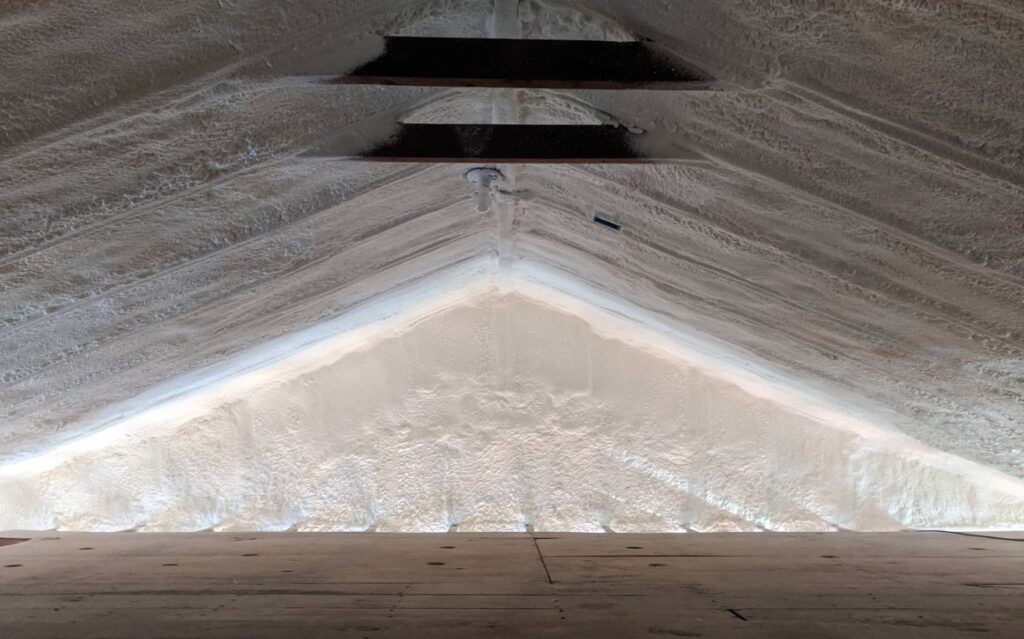
- Attics and roof decks (in vented or properly designed unvented assemblies)
- Interior walls where sound dampening matters
- Additions and renovations where budget-per-square-foot is a bigger factor than maximum R-value
One Code Requirement Both Types Share: A Thermal Barrier
Whichever type you choose, building codes require exposed spray foam in living spaces — an unfinished basement or attic where the foam isn’t covered by drywall or another approved material — to be protected by a thermal (often called an “ignition”) barrier. This is a fire-safety requirement, not an optional upgrade, and it applies equally to open-cell and closed-cell foam. A licensed installer will factor this into the job from the start, either by installing an approved coating or by confirming that the space will be finished with drywall afterward. If a contractor doesn’t mention this step, it’s worth asking about directly.
So Which Is Right for Your Connecticut Home?
Connecticut’s climate — cold, damp winters and humid summers — means most homes in Fairfield, New Haven, and Litchfield Counties actually benefit from a combination of both: closed-cell foam in moisture-prone areas like basements and rim joists, and open-cell foam in attics and interior walls where its lower cost and sound-dampening properties make more sense. The right mix depends on your home’s age, construction, and where your current insulation is failing — which is exactly what a proper on-site assessment is for.
At Right Way Insulation, we install both open-cell and closed-cell spray foam for homeowners throughout Fairfield County, New Haven County, Litchfield County, and Westchester County, NY. If you’re not sure which type your project needs, contact us for a free assessment — we’ll walk your space, explain what we’d recommend and why, and give you a clear, no-obligation quote before any work begins.