(203) 550-1846
 rwinsulation@gmail.com
The biggest difference between spray foam and traditional batt (fiberglass) insulation isn’t really about R-value — it’s about air sealing. Batt insulation slows heat transfer through a material, but it doesn’t stop air from moving through gaps around it. Spray foam does both at once, which is why two homes with the “same” R-value on paper can perform very differently in real heating and cooling bills.
How Batt Insulation Works
Fiberglass or mineral wool batts are cut to fit between wall studs, floor joists, or roof rafters, where they work by trapping pockets of air within the material to slow heat transfer. Batts are inexpensive and straightforward to install, which is why they’ve been the default choice in home construction for decades. Their performance, though, depends entirely on a perfect, gap-free installation — any compression, gap, or settling reduces their effective R-value significantly, and batts do nothing to stop air from moving around, through, or past them.
How Spray Foam Insulation Works
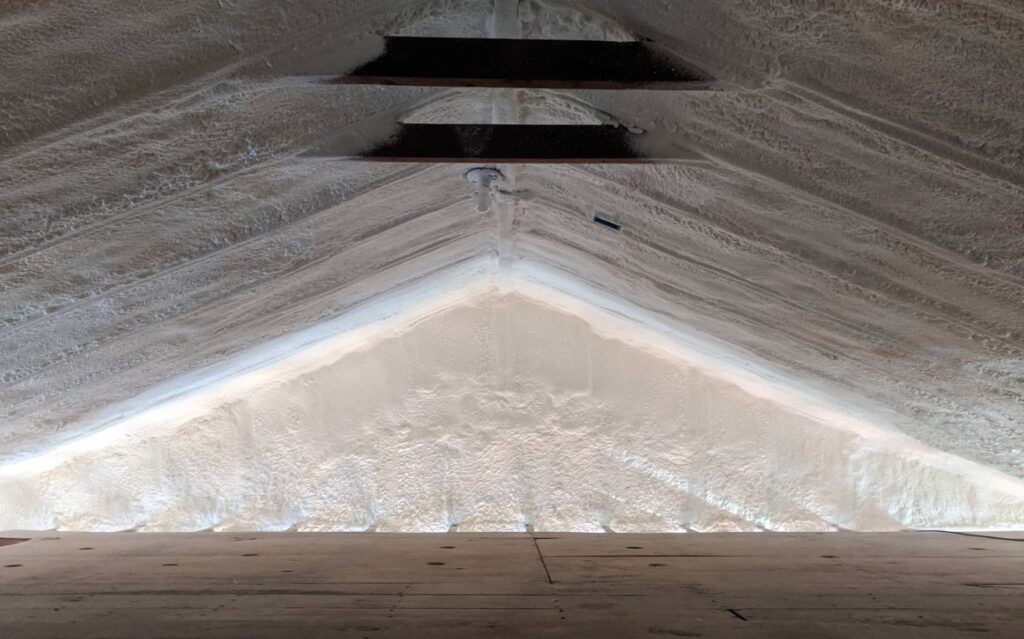
Spray foam expands on contact to fill the entire cavity it’s sprayed into, conforming to every irregular gap, wire, and pipe penetration in the space. In doing that, it accomplishes two things simultaneously: it insulates the cavity, and it creates a continuous air seal across the whole surface. That combination — insulation plus air barrier in a single material — is the core reason spray foam consistently outperforms batt insulation in real-world energy use, even in cases where the R-value numbers on paper look similar.
R-Value Per Inch: How the Numbers Actually Compare
Standard fiberglass batts provide roughly R-3.1 to R-3.8 per inch depending on density and product. Open-cell spray foam provides about R-3.5 to R-3.6 per inch — similar to batts — while closed-cell spray foam provides roughly R-6 to R-7 per inch, nearly double. On paper, open-cell foam and batts look comparable. In practice, they don’t perform the same, because R-value only measures resistance to heat conduction through a material — it says nothing about air leakage, which is where batt insulation loses most of its real-world effectiveness.
Air Sealing: The Factor Most Homeowners Miss
According to ENERGY STAR, air leakage accounts for between 25% and 40% of the energy used for heating and cooling in a typical home. That’s a bigger share of your energy loss than most homeowners assume, and it’s largely invisible — it happens at electrical boxes, top and bottom wall plates, rim joists, plumbing penetrations, and the countless small gaps that batt insulation is simply not designed to seal. A “properly installed” batt job can still leave a home leaking air at all of these points, because sealing them isn’t what batt insulation does. Spray foam addresses this by its nature, since it expands into and seals those same gaps as it cures.
Long-Term Performance and Durability
Fiberglass batts can sag, settle, or get compressed over time — by gravity, by pests, by moisture, or simply by being disturbed during other work in the attic or walls — and each of those reduces the insulation’s effective R-value below what it was rated for on install day. Spray foam, once cured, is dimensionally stable. It doesn’t sag, settle, or lose loft, so its performance on day one is much closer to its performance ten or twenty years later.
Moisture and Mold Resistance
Fiberglass batts can absorb and hold moisture if a leak or condensation issue develops nearby, which both reduces their insulating value and creates conditions for mold growth. Closed-cell spray foam is water-resistant and won’t wick moisture the way fiberglass does; open-cell foam is more vapor-open but still doesn’t hold water the way saturated fiberglass does. This is one of the reasons spray foam is generally the better choice in basements, crawl spaces, and rim joists — areas of a Connecticut home where moisture exposure is a realistic, ongoing risk.
Cost and Payback Considerations
Batt insulation has a lower upfront material and labor cost, which is why it’s still common in new construction and budget-driven renovations. Spray foam costs more upfront, but because it addresses air leakage directly — the factor responsible for a large share of a typical home’s heating and cooling losses — it often reduces energy bills more than the R-value comparison alone would suggest, and some spray foam projects can qualify for utility efficiency programs or rebates. Because actual costs depend on square footage, foam type, and site conditions, we provide a free on-site estimate rather than a flat price per square foot, so you can weigh the real numbers for your specific project.
Installation Speed and Disruption
Batt insulation is fast to install and requires no cure time — it’s simply cut and fitted into place, which is part of why it remains popular for quick renovation timelines. Spray foam takes longer per job and requires the treated area to be vacated during application and for a period afterward while it cures (typically at least 24 hours, depending on the product). For an occupied home, that’s a real scheduling consideration, though most homeowners find the trade-off worthwhile once they see the difference in comfort and energy bills afterward.
A Word on Soundproofing
If reducing noise between rooms is part of your goal — not just energy efficiency — it’s worth knowing that open-cell spray foam and fiberglass batts both outperform closed-cell foam for sound dampening, since their more open structures absorb sound waves rather than reflecting them. This is a case where the “best” insulation for energy performance (closed-cell, in a high-moisture area) isn’t necessarily the best choice for acoustic comfort, and it’s worth discussing both goals with your installer rather than optimizing for R-value alone.
Which One Is Right for Your Project?
If you’re working with a tight budget on a straightforward renovation and air sealing has already been addressed separately, batt insulation can still be a reasonable choice for some interior applications. But for whole-home energy efficiency upgrades, additions, new construction, or any space with irregular framing, wiring, or plumbing — attics, rim joists, crawl spaces — spray foam’s combined insulation-and-air-seal performance generally delivers a better long-term result, both in comfort and in what you actually pay to heat and cool the home.
At Right Way Insulation, we install spray foam insulation for homes and additions throughout Fairfield County, New Haven County, and Litchfield County, CT, and Westchester County, NY. If you’re deciding between spray foam and traditional insulation for your project, contact us for a free assessment — we’ll look at your specific space and give you a straightforward recommendation, not just a sales pitch for the most expensive option.